


Master the Sudoku Pointing Pairs Technique
What is a Pointing Pair?
A pointing pair occurs when a specific Note (candidate) appears only two or three times within a single 3x3 block, and all those instances happen to be aligned in the same row or column.
Because that number must be the solution for one of those cells inside that block, it effectively "points" along the line. This logical locking means you can safely eliminate that candidate from any other cells in the rest of the row or column outside of that specific block.
How to Find and Apply This Strategy
Identifying this pattern requires a keen eye for candidate distribution. To understand this technique better, let's analyze the example in the bottom-right 3x3 block and its relationship with Column 9.
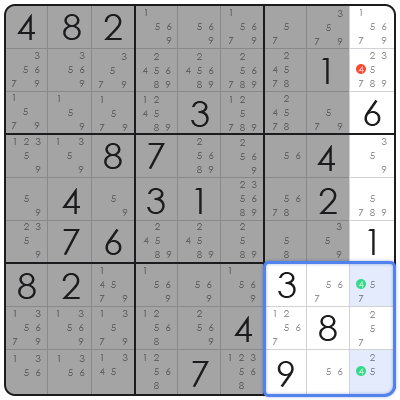
In this specific grid area, we have the following candidates:
- Column 9 Notes (Outside Block):
R1C9 = {1, 5, 6, 7, 9}
R2C9 = {2, 3, 4, 5, 7, 8, 9} (The target "victim" cell)
R4C9 = {3, 5, 9}
R5C9 = {5, 7, 8, 9}
- Bottom-Right Block Notes:
R7C9 = {4, 5, 7}
R9C9 = {2, 4, 5}
(Other cells in this block do not contain candidate '4')
Step 1: Scan the Notes Inside the Block
Look at the candidates only inside the bottom-right block. We are searching for a number confined to a single line. We find that the candidate '4' only appears in two cells within this box: R7C9 and R9C9.
Step 2: Identify the Locked Candidates
Since both of these cells are located in Column 9, they form this specific pattern. The logic is simple: Number '4' must exist somewhere in the bottom-right block. Since these are the only two possible spots, one of them must be 4. Therefore, the '4' for this block is "locked" into Column 9.
Step 3: Eliminate Notes from the Rest of the Row or Column
Knowing that the '4' for Box 9 is restricted to Column 9, we can clear all other '4's from the rest of the column. This is a powerful candidate eliminator that helps simplify the board.
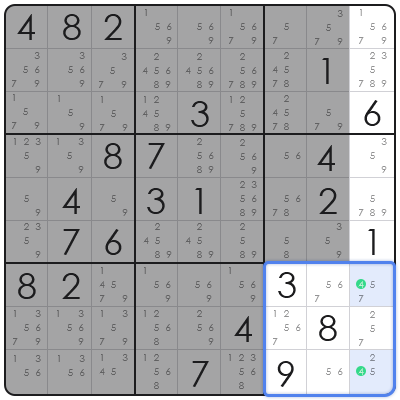
In our "victim" cell, R2C9, the notes are {2, 3, 4, 5, 7, 8, 9}. Because our logic dictates that 4 must be in the bottom block, we can safely delete '4' from R2C9 and any other cells in the rest of the row if the pair were aligned horizontally.
Why Mastering This Technique is Essential
While pointing pairs may seem simple, they are the foundation for more advanced strategies like "Pointing Triples" or "Box-Line Reduction." Using this sudoku technique regularly will help you solve Hard Sudoku puzzles where naked singles are no longer visible.
Ready to practice? We encourage you to start a new game of Medium Sudoku or Hard Sudoku to put this theory into action. Can you find a candidate to eliminate from the rest of the row in your next puzzle?
Next Steps
Once you are comfortable with this method, you can proceed to the next strategy: Pointing Triples, which applies the same logic to three cells instead of two.
Ready to Use the Pointing Pairs Technique in a Real Puzzle?
Pointing Pairs are easiest to understand once you actually eliminate a candidate yourself.
Choose a Medium or Hard puzzle, turn on Notes, and scan each 3×3 block for a number that only appears in one row or one column.
Tip: If eliminating a candidate outside the block unlocks a new single, you’ve applied Pointing Pairs correctly