


What Is Sudoku Evil? Difficulty, Rules, and How It Compares
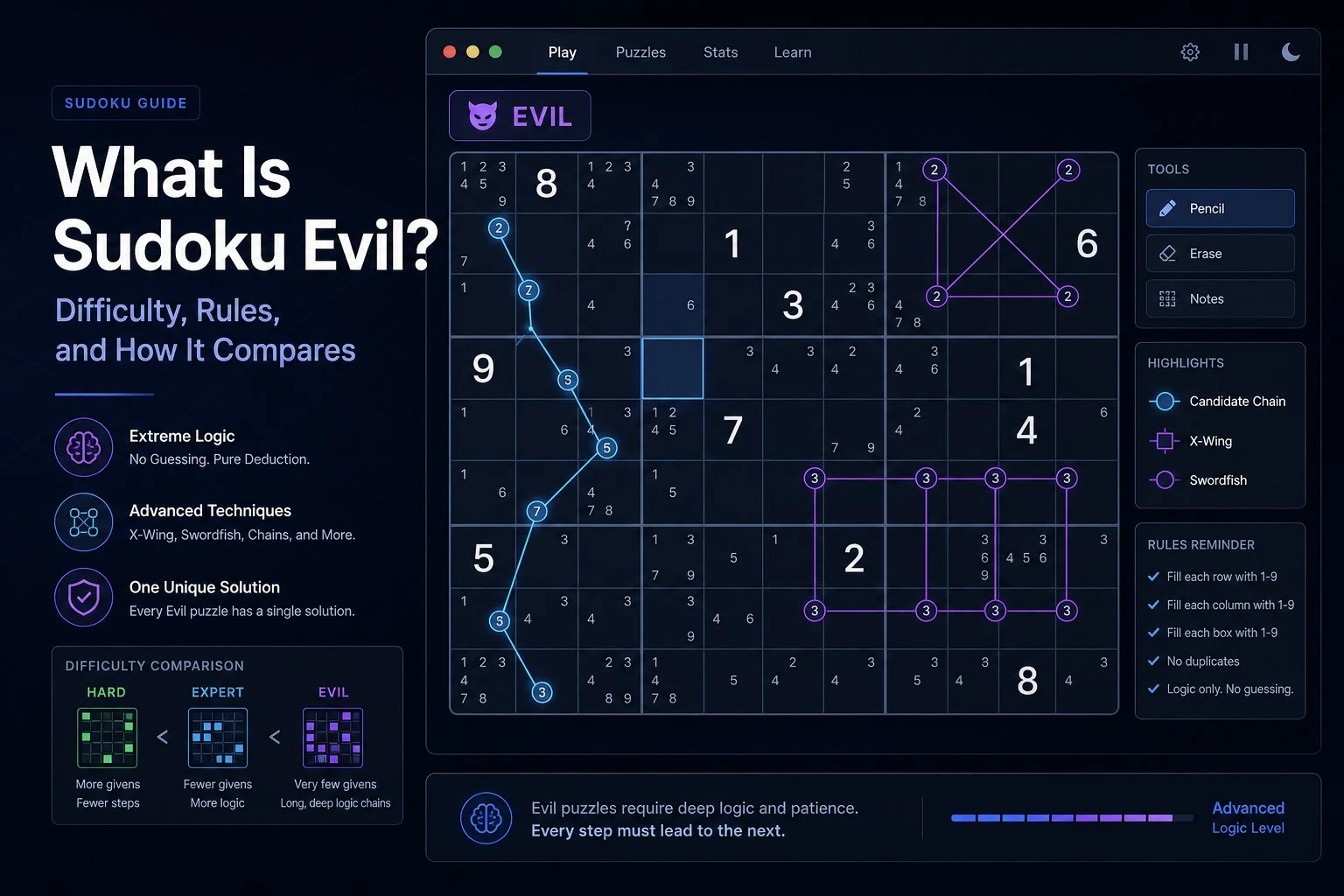
Web Sudoku Evil is the highest difficulty tier on most online Sudoku platforms, featuring as few as 17 given numbers—the mathematical minimum for a unique solution. It requires advanced techniques like X-Wing, Swordfish, and XY-Wing that separate casual players from serious solvers. Unlike Hard or Expert levels that rely on simpler local elimination strategies, Evil puzzles demand multi-step logical chains tracing candidate relationships across many cells before producing a single elimination.
What does "evil" mean in Sudoku difficulty?
Evil Sudoku (also called Master Sudoku) is a 9×9 grid puzzle at the highest difficulty level, designed for experienced solvers who have moved beyond basic logic. Evil puzzles start with far fewer given numbers than lower levels—often only 17 pre-filled digits—which makes them extremely difficult to solve.
Easy puzzles provide 35–40 starting numbers; Evil gives you the mathematical minimum for a unique solution. Simple logic and basic Sudoku rules won't suffice—you must know advanced solving techniques and understand how to apply them in practice. LoveSudoku's Evil level is calibrated to require specific advanced techniques, ensuring the "evil" label reflects genuine difficulty rather than arbitrary marketing.
Evil vs. hard vs. expert: How difficulty levels compare
Hard Sudoku keeps techniques local (pointing pairs, box-line reduction, triples), while Expert puzzles introduce grid-spanning techniques like fish patterns and wings that require scanning across multiple non-adjacent rows or columns simultaneously. Expert puzzles have fewer starting clues (22–26 vs. 26–30 for Hard), creating a denser candidate grid with more possibilities per cell.
Evil puzzles require chains—multi-step logical sequences that trace candidate relationships across many cells before producing a single elimination—and have even fewer starting clues (17–22). Evil adds nine more technique types beyond Expert: Y-Wing, XYZ-Wing, Finned/Sashimi X-Wing, Empty Rectangle, W-Wing, and four types of Unique Rectangle.
| Difficulty Level | Typical Givens | Key Techniques Required | Cognitive Demand |
|---|---|---|---|
| Hard | 26–30 | Pointing pairs, box-line reduction, triples | Local pattern recognition |
| Expert | 22–26 | X-Wing, Swordfish, basic fish patterns | Grid-spanning visual scanning |
| Evil | 17–22 | Chains, Y-Wing, XYZ-Wing, Unique Rectangles | Abstract multi-step reasoning |
Test each level directly on LoveSudoku's Hard and Expert puzzle pages to feel the difference firsthand.
Advanced techniques required for evil Sudoku
Evil-difficulty puzzles require X-Wings, Swordfish, and forcing chains—techniques that aren't intuitive without training. The XY-Wing strategy is an advanced elimination technique using three cells with exactly two candidates each: a pivot cell (XY) and two pincers (XZ and YZ). Any cell intersecting both pincers cannot contain digit Z.
Swordfish is a 3×3 nine-cell pattern where a candidate appears in exactly three different rows (or columns) and lines up in the opposite direction, allowing eliminations outside the pattern. X-Wing is a straightforward technique with an easily identifiable rectangle pattern that focuses on one single digit to restrict the number of cells that can have that number as a candidate.
Expert techniques like X-Wing have recognizable rectangle shapes, while Evil techniques like alternating inference chains require abstract reasoning ("if this cell is 5, then that cell can't be 3, which means…"). LoveSudoku's strategy guides explain each technique with worked examples, showing why a move works rather than just when to apply it.
Why pencil marks are essential for evil puzzles
Pencil marks—small numbers listing all possible values for each unsolved square—are essential for completing Fiendish or Super Fiendish puzzles and mandatory for Evil. Pencil marking lets you type multiple optional digits in a specific cell, allowing you to narrow down all the optional numbers systematically.
While digital platforms track candidates automatically, paper strengthens memory—and for evil-level puzzles, paper can be easier for drawing constraint lines and tracking complex eliminations. LoveSudoku's interface supports sudoku pencil marks with one-click candidate entry, keeping the grid clean while tracking all possibilities.
Pencil marks = candidate notation showing which digits remain possible in each empty cell.
How to know if you're ready for evil-level puzzles
You're ready to advance when you can solve your current level under 20 minutes consistently, with no getting stuck and no frustration. The prerequisite skill stack begins with scanning and basic elimination, then naked singles and hidden singles—these four methods solve most easy and medium puzzles.
Once you've learned X-Wing and Swordfish, Expert-level puzzles will test those skills—master Expert before attempting Evil. The jump to Expert is the steepest difficulty increase in Sudoku; focus on learning one new technique at a time rather than trying to learn everything at once.
Build your foundation with LoveSudoku's Medium puzzles as stepping stones, using time benchmarks to track your progress objectively.
Evil, diabolical, and fiendish: Understanding Sudoku difficulty names
Some platforms use multiple terms above "hard"—one site grades puzzles as Evil, Excessive, Egregious, Excruciating, and Extreme in order from least difficult to most difficult. UK newspapers use different terminology: The Times uses "Fiendish" and "Super Fiendish," while The Daily Telegraph uses "Diabolical"—these roughly correspond to Evil-tier difficulty.
Terms like Sudoku Diabolical, Sudoku Very Hard, Sudoku Evil, Sudoku Expert, and Sudoku Extreme are often used interchangeably across publishers and platforms. The Times introduced "Super Fiendish" in November 2006 as a new extreme level requiring more difficult logic.
LoveSudoku uses "Evil" as its highest tier, calibrated to require specific advanced techniques—the label reflects measurable difficulty, not marketing drama.
Where to play web Sudoku evil online for free
Multiple platforms offer Evil Sudoku: websudoku.com, sudoku.com, livesudoku.com, and others all provide free evil-level puzzles. Web Sudoku Evil is described as a very hard level—so hard it is evil—designed for expert solvers.
Most platforms offer unlimited free puzzles with no ads and no registration required, working on phone, tablet, and desktop. Unlike platforms that offer puzzles without explanation, LoveSudoku pairs Evil puzzles with 16 strategy guides covering every technique from Hidden Singles to Swordfish—so you learn why a move works, not just that it exists.
LoveSudoku saves progress locally with no account required, respecting your privacy while preserving solve state.
Play evil Sudoku now on lovesudoku.net
Start solving immediately on LoveSudoku's Evil puzzle page. Every Evil puzzle is guaranteed to have exactly one solution reachable through pure logic—no guessing required.
LoveSudoku's six difficulty levels (Beginner through Evil) create a structured progression path, so if you aren't ready for Evil, you can start at your current skill level and advance. Instant play in any browser, no download, no account creation, available in 11 languages.
For a deeper guide before jumping into puzzles, read the Web Sudoku Evil Play Free article.
Frequently Asked Questions
What is Web Sudoku Evil and how hard is it compared to other difficulty levels?
Web Sudoku Evil is the highest difficulty tier in most online Sudoku platforms, featuring as few as 17 given numbers—the mathematical minimum for a unique solution. It requires advanced techniques like X-Wing, Swordfish, and XY-Wing that most players never learn, making it significantly harder than Hard or Expert levels which rely on simpler local elimination strategies.
How is Evil Sudoku different from Hard Sudoku?
Hard Sudoku uses local techniques like pointing pairs and box-line reduction that operate within single units or adjacent areas. Evil Sudoku requires grid-spanning techniques and multi-step logical chains that trace candidate relationships across many cells before producing a single elimination—a fundamentally different cognitive skill.
What advanced techniques do you need to solve Evil Sudoku online?
Evil Sudoku requires X-Wing (a 2×2 rectangle pattern for candidate elimination), Swordfish (a 3×3 nine-cell pattern), XY-Wing (using three bi-value cells to eliminate candidates), and forcing chains. These techniques aren't intuitive without training and separate casual players from serious solvers.
Where can I play Web Sudoku Evil online for free?
Several platforms offer free Evil Sudoku including websudoku.com, sudoku.com, livesudoku.com, and lovesudoku.net. LoveSudoku differentiates by pairing every Evil puzzle with strategy guides that explain the techniques required to solve without guessing, plus local progress saving with no account required.
Is Evil the hardest level in Web Sudoku?
On most platforms, Evil is the hardest standard difficulty level. However, some sites use additional tiers above Evil—one platform grades puzzles as Evil, Excessive, Egregious, Excruciating, and Extreme in ascending difficulty. The techniques required remain similar: chains, fish patterns, and advanced wings.