


How Long to Solve Sudoku? A Detailed Guide to Timing
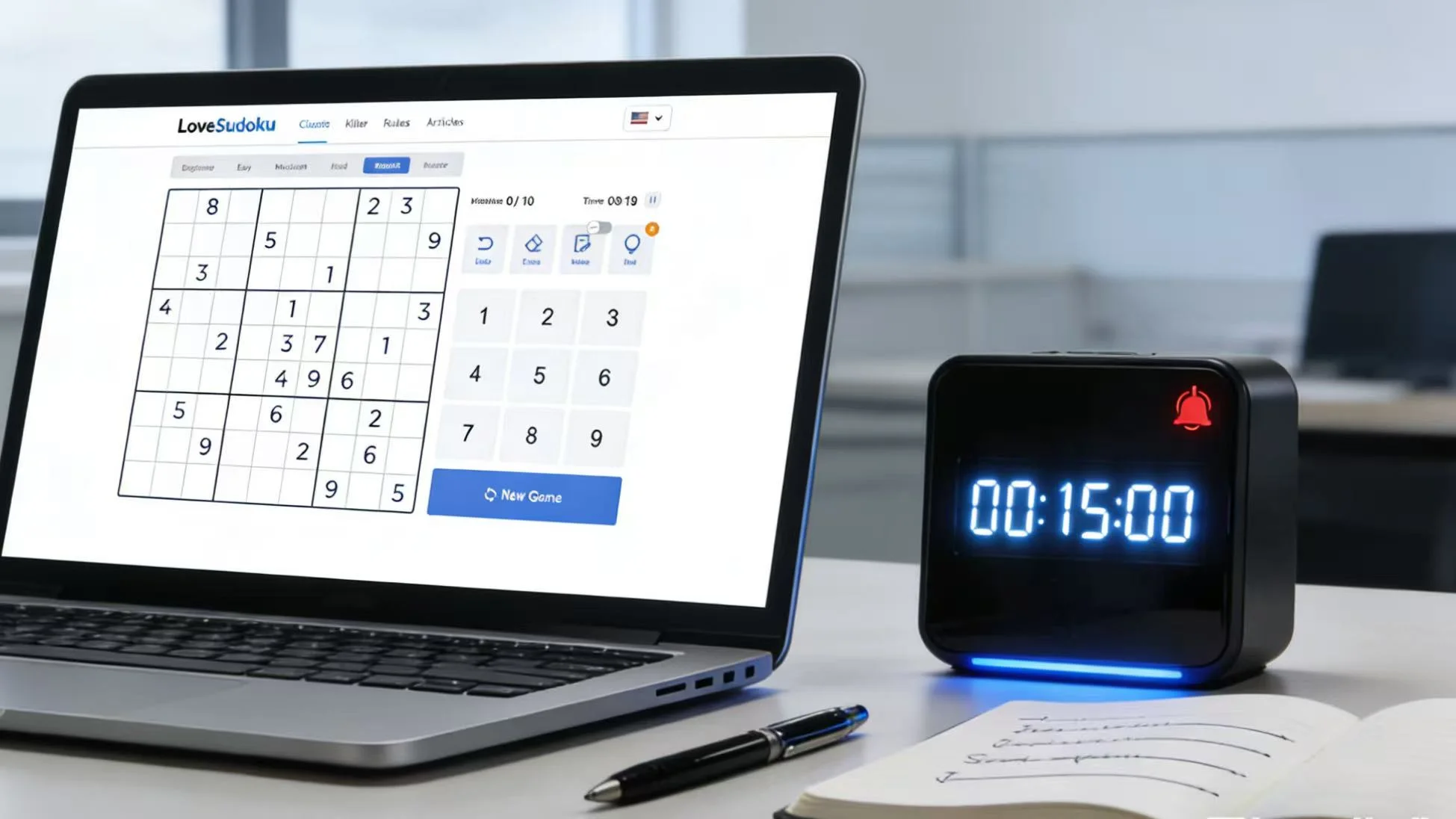
Have you ever looked at a "Evil" puzzle for more than an hour? Did you give up in frustration or start guessing? Or perhaps you’ve watched World Sudoku Championship on YouTube breeze through an expert grid in minutes and wondered what their "secret sauce" is.
Time isn't just a measure of speed; it’s a diagnostic report for your logical proficiency. Comparing raw times can lead to unnecessary anxiety.
This guide shows the real benchmarks from beginner to expert. It also teaches you how to analyze your "stuck time." This helps you learn where your skills need improvement.
Global Benchmarks: Setting Realistic Expectations
Before you stress over the clock, remember that "difficulty" varies wildly between different apps and newspapers. Use these average sudoku time as a general compass to find your current standing:
- Easy / Beginner: 5–15 minutes. Solving relies mostly on "Naked Singles" (cross-hatching) and quick scanning. You require little to no pencil marking.
- Medium: 10–20 minutes. You will need a clear way to track "candidates" (sudoku notes). Use simple logic, like "Naked/Hidden Pairs," to remove options.
- Hard: 20–45 minutes. These puzzles demand advanced pattern recognition. You’ll frequently encounter techniques like X-Wings or Swordfish to break through bottlenecks.
- Expert / Evil: 30–90+ minutes (Casuals) vs. 15–20 minutes (Pros). This is where the "skill chasm" appears.
Casual players often find themselves stuck in cycles of trying and failing. In contrast, pros, seen on popular channels, ignore the difficulty level. They break down the grid using clear logical steps.
The Key Takeaway: Speed isn't about how fast your fingers move; it’s about the depth of your "logical arsenal."
Deconstructing the Clock: What Does Your "Stuck Time" Reveal?
This is the heart of the matter. Stop looking at the total time and start diagnosing where you are losing it. Your bottlenecks point directly to your missing skills.
If you’re stuck at the start (The Scanning Phase)
- Symptoms: You stare at a fresh grid for five minutes and can’t find a single digit to place.
- Diagnosis: Lack of a systematic scanning method. You’re likely hunting for random numbers rather than using a structured process.
- The Fix: Master "Snyder Notation." This method involves only marking a candidate if it can only go in two cells within a 3x3 box. The gold standard for speed-solving keeps the grid clean and reveals "locked candidates" instantly.
If you hit a wall in the middle (The Logic Gap)
- Symptoms: The grid is half-full, but it’s covered in messy pencil marks. You feel like you have exhausted all obvious leads, and you feel tempted to make a "guess."
- Diagnosis: You’ve reached a logic plateau. You know individual techniques, but you struggle to bridge them together. This is the "missing link" for most intermediate players.
- The Deep Dive: Research into high-level puzzles (like the "Impossible 520" series) shows that even the toughest grids have a pure logical path. You aren't missing luck; you're missing a specific technique.
- The Fix: It’s time to upgrade your toolkit. Learn advanced strategies like X-Wings, Y-Wings, and Swordfish. These focus on relationships between cells across the entire grid.
Feeling stuck here? Check out our advanced guide: “How to Get Better at Sudoku: Expert Tips and Tricks” to bridge the gap.
If you’re slow at the end (The Cleanup Phase)
- Symptoms: The hard part is done. Just simple fill-in-the-blanks, but you’re still moving slowly or making "silly" mistakes.
- Diagnosis: UI friction or mental fatigue. You might be struggling with the app's interface or losing focus during the "mechanical" part of the solve.
- The Fix: If using an app, enable "Auto-highlight duplicates." Practice your "Naked Single" scanning to increase your "clerical" speed. Stay sharp until the utmost last digit.
The Tool Factor: Websites & Apps vs. Paper
The medium you choose significantly impacts your time, a factor often overlooked in online discussions.
- Pencil and paper: Solving problems on paper is a classic experience. It often takes 20% to 50% more time than using digital tools. Without automated features, you must manually scan every cell and keep track of your own "pencil marks" (candidates).
Fixing mistakes takes time. Without a "hint" button, you must rely completely on your brain. This makes it a true test of mastery.
- Websites & Apps: Developers design modern products on platforms like LoveSudoku.net for speed and convenience. Features such as automatic candidate highlighting and instant error checking save a lot of time.
One-touch pencil markings also help reduce the time needed to solve problems. This helps advanced players get times under five minutes.
However, beginners should be careful not to depend too much on these "crutches." They can skip the important logical training that comes from solving manually.
Speed Solving vs. Logical Solving: Which Path Are You On?
Before chasing the clock, define your goal:
- Speed Solving: This is a competitive sport. It relies on muscle memory and lightning-fast pattern recognition. It’s about "seeing" rather than "thinking."
- Logical Solving: This is the art of the puzzle. The joy comes from the "Aha!" moment when a complex logical chain collapses a difficult section. As proven by academic analyses of the hardest puzzles, there is always a logical path—no guessing required.
Mindset Shift: For most players, speed is a byproduct of logic, not the goal itself. Don't guess to save time; that robs you of the progress that actually makes you faster.
How to Cut Your Time (Without Guessing)
Here are three actionable ways to improve sudoku time:
- Refine Your Notation: Master Snyder Notation to reduce visual noise and identify "Locked Candidates" faster.
- Drill Basic Patterns: Make "Naked/Hidden Pairs" and "Triples" a reflex. They are the building blocks of every advanced chain.
- Deliberate Practice: Don't just solve aimlessly. Spend one session specifically looking for X-Wings, and another focusing on speed-scanning.
Summary
Your solve time is a mirror of your current skill level. The secret to dropping from 30 minutes to 15 isn't moving your fingers faster—it’s seeing the logical chains that others miss.
Ready to test your sudoku speed and apply these new insights?
Head over to lovesudoku.net, pick a puzzle that challenges you, and pay attention to where the clock is ticking.
Diagnose your bottlenecks and start your journey to becoming a Sudoku expert today!