


Sudoku Strategies Explained: Beginner to Expert Techniques
Sudoku puzzles can be solved logically without guessing. By learning a set of proven Sudoku solving strategies, players can identify patterns, eliminate impossible numbers, and gradually complete the puzzle grid.
This guide introduces the most common Sudoku techniques, organized by difficulty level. Each strategy links to a detailed explanation page with examples and step-by-step instructions.
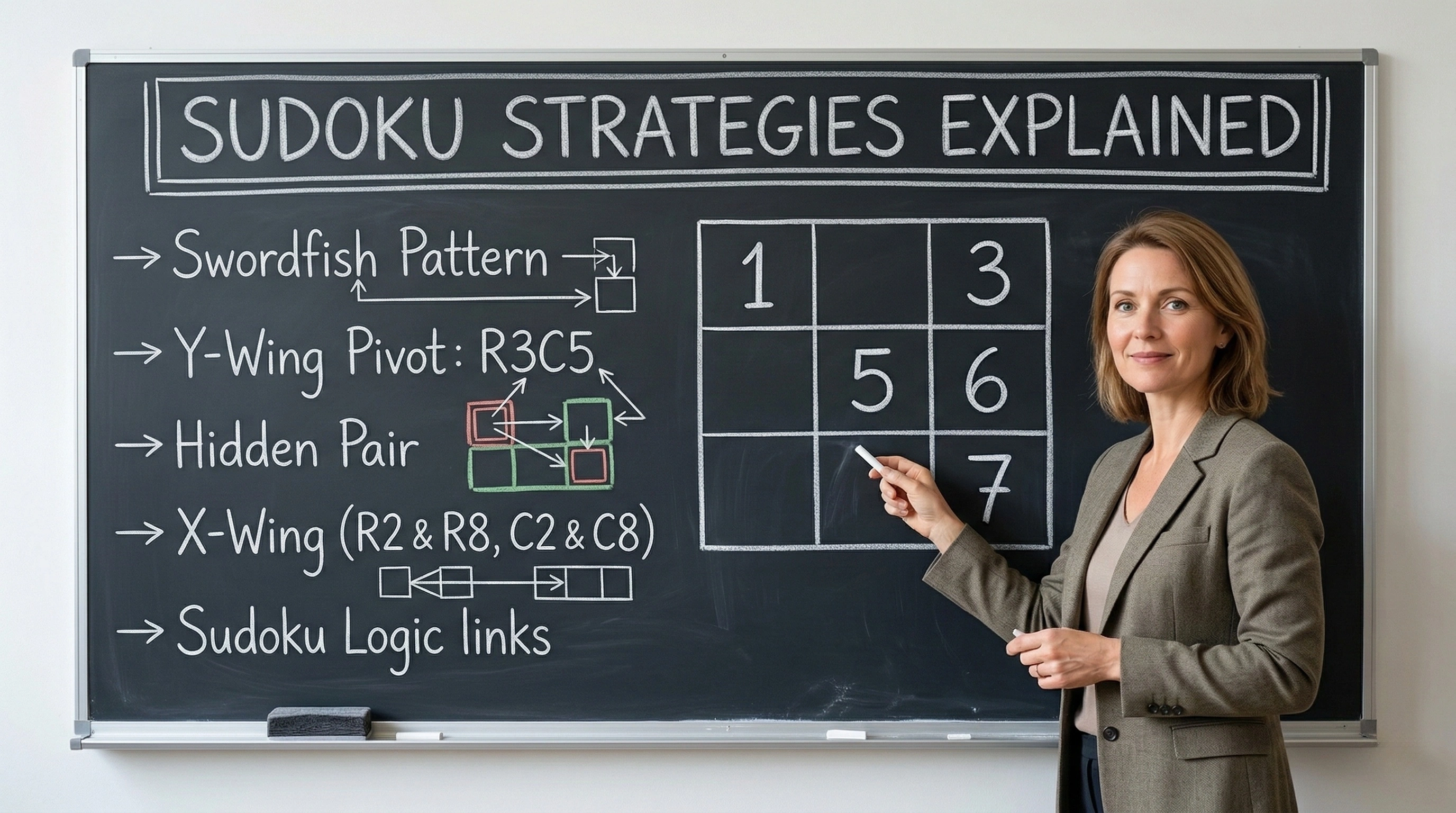
What Are Sudoku Solving Strategies?
Sudoku strategies are logical techniques used to determine where numbers should be placed in a Sudoku grid. Instead of guessing, players analyze rows, columns, and 3×3 boxes to eliminate impossible candidates.
Most Sudoku puzzles can be solved using a small set of core strategies, starting with simple elimination methods and progressing to advanced pattern-recognition techniques.
Common Sudoku Strategies Overview
| Strategy | Difficulty | Key idea (1-line) | Guide |
|---|---|---|---|
| Last Free Cell | Beginner | Fill the final empty cell in a row/column/box by placing the only missing digit. | Last Free Cell strategy guide |
| Last Remaining Cell | Beginner | Place a digit when it has only one possible position in a unit. | Last Remaining Cell guide |
| Last Possible Number | Beginner | Place a digit when a cell has only one valid candidate left. | Last Possible Number guide |
| Sudoku Notes | Beginner | Use pencil marks to track candidates and support eliminations. | How to use Sudoku notes |
| Obvious Singles | Intermediate | A cell has a single candidate, so it must be that digit. | Obvious Singles guide |
| Obvious Pairs | Intermediate | Two cells share the same two candidates; eliminate them elsewhere in the unit. | Obvious Pairs guide |
| Obvious Triples | Intermediate | Three cells restrict three digits; eliminate them from other cells in the unit. | Obvious Triples guide |
| Hidden Singles | Intermediate | A digit appears as a candidate only once in a unit. | Hidden Singles guide |
| Hidden Pairs | Intermediate | Two digits appear only in the same two cells in a unit; strip other candidates. | Hidden Pairs guide |
| Hidden Triples | Intermediate | Three digits are confined to three cells in a unit; remove other candidates. | Hidden Triples guide |
| Pointing Pairs | Advanced | Candidates in a box align in one row/column, enabling eliminations outside the box. | Pointing Pairs guide |
| Pointing Triples | Advanced | Like pointing pairs but with three aligned candidate positions. | Pointing Triples guide |
| X-Wing | Advanced | A rectangle pattern in 2 rows × 2 columns eliminates candidates across the grid. | X-Wing guide |
| Y-Wing | Advanced | A 3-cell “pivot + wings” pattern enables candidate eliminations. | Y-Wing guide |
| Swordfish | Advanced | A 3-row/3-column fish pattern eliminates candidates similar to X-Wing. | Swordfish guide |
This overview summarizes the most commonly used Sudoku techniques and provides links to detailed explanations.
Beginner Sudoku Strategies
Beginner strategies rely on simple logical deductions and are commonly used in easy puzzles.
Last Free Cell
Last Free Cell is a beginner Sudoku solving technique where a row, column, or 3×3 box has only one empty cell remaining, allowing the missing number to be placed immediately.
Learn more: How the Last Free Cell Sudoku strategy works
Last Remaining Cell
Last Remaining Cell is a Sudoku technique where a specific number can appear in only one position within a row, column, or box after eliminating other possibilities.
Learn more: How the Last Remaining Cell Sudoku strategy works
Last Possible Number
Last Possible Number is a Sudoku strategy where a cell has only one valid candidate left after checking the constraints of its row, column, and 3×3 box.
Learn more: How the Last Possible Number Sudoku strategy works
Sudoku Notes (Pencil Marks)
Sudoku Notes (also called pencil marks) is a technique used to record candidate numbers inside cells to help track possibilities and support logical elimination.
Learn more: How to use Sudoku Notes effectively
Intermediate Sudoku Strategies
Intermediate techniques involve candidate tracking and logical elimination patterns.
Obvious Singles
Obvious Singles is a Sudoku solving technique where a cell contains only one possible candidate number, making it the clear solution for that position.
Learn more: How the Obvious Singles Sudoku strategy works
Obvious Pairs
Obvious Pairs is a Sudoku technique where two cells in the same row, column, or box share the same pair of candidate numbers, allowing those numbers to be eliminated from other cells in that unit.
Learn more: How the Obvious Pairs Sudoku strategy works
Obvious Triples
Obvious Triples is a Sudoku strategy where three cells together restrict three specific numbers, preventing those numbers from appearing in other cells within the same unit.
Learn more: How the Obvious Triples Sudoku strategy works
Hidden Singles
Hidden Singles is a Sudoku solving technique where a number appears only once as a possible candidate within a row, column, or box, even if the cell contains multiple candidates.
Learn more: How the Hidden Singles Sudoku strategy works
Hidden Pairs
Hidden Pairs is a Sudoku strategy where two numbers appear only in the same two cells within a unit, allowing other candidates in those cells to be removed.
Learn more: How the Hidden Pairs Sudoku strategy works
Hidden Triples
Hidden Triples is a Sudoku technique where three numbers are restricted to three specific cells within a row, column, or box, enabling the elimination of other candidates in those cells.
Learn more: How the Hidden Triples Sudoku strategy works
Advanced Sudoku Strategies
Advanced strategies rely on pattern recognition across rows and columns.
Pointing Pairs
Pointing Pairs is a Sudoku strategy where a candidate number appears only in one row or column within a 3×3 box, allowing that candidate to be eliminated from the same row or column outside the box.
Learn more: How the Pointing Pairs Sudoku strategy works
Pointing Triples
Pointing Triples is a variation of the pointing pairs technique where three candidate positions within a box align in the same row or column, enabling eliminations elsewhere in that line.
Learn more: How the Pointing Triples Sudoku strategy works
X-Wing
X-Wing is an advanced Sudoku pattern where a candidate number appears exactly twice in two different rows and columns, forming a rectangle that allows eliminations in other cells of those rows or columns.
Learn more: How the X-Wing Sudoku strategy works
Y-Wing
Y-Wing is a Sudoku solving technique that uses a pivot cell connected to two wing cells to create a logical chain that eliminates candidates elsewhere in the grid.
Learn more: How the Y-Wing Sudoku strategy works
Swordfish
Swordfish is an advanced Sudoku pattern similar to X-Wing but involving three rows and three columns, allowing candidate eliminations across the puzzle grid.
Learn more: How the Swordfish Sudoku strategy works
Strategy Difficulty Comparison
| Category | Example Strategies | Typical Puzzle Level |
|---|---|---|
| Beginner | Last Free Cell, Obvious Singles | Easy |
| Intermediate | Hidden Singles, Hidden Pairs | Medium |
| Advanced | X-Wing, Y-Wing | Hard |
| Advanced | Swordfish | Expert |
Key Takeaways
- Sudoku puzzles can be solved logically without guessing
- Most puzzles rely on a small set of core strategies
- Beginner techniques include Last Free Cell and Obvious Singles
- Advanced puzzles may require X-Wing or Swordfish
Practice Sudoku Strategies
The best way to learn Sudoku techniques is by applying them in real puzzles.
Practice directly on the LoveSudoku online Sudoku board
Frequently Asked Questions
What is the easiest Sudoku strategy?
Beginner strategies such as Last Free Cell and Obvious Singles are the easiest techniques.
What strategies solve difficult Sudoku puzzles?
Hard puzzles often require advanced techniques such as X-Wing, Y-Wing, and Swordfish.
Do expert Sudoku players guess?
No. Experienced players rely on logical deduction rather than guessing.
References
Sudoku strategy terminology and solving patterns are widely documented in major puzzle platforms and Sudoku reference guides, including:
- Wikipedia — Sudoku overview and rules
- Conceptis Puzzles — Sudoku solving techniques
- SudokuWiki — strategy explanations and pattern references
- Nikoli — Sudoku (origin / puzzle publisher reference)