


Master the Sudoku Y-Wing Technique
What is the Sudoku Y-Wing Strategy?
The sudoku y wing (also frequently called the XY-Wing) is a powerful sudoku technique used when basic logic reaches its limit. It belongs to the broader wing strategy family, acting as a highly effective candidate eliminator for the most difficult sudoku puzzle grids.
Unlike the X-Wing which forms a rectangle, the y wing sudoku pattern relies on three specific "bi-value" cells. A bi-value cell is a cell that contains exactly two notes (candidates). Understanding the connection between these three cells is key to unlocking advanced levels.
How to Find a Y-Wing Step-by-Step
To identify this pattern in a sudoku puzzle, follow this systematic approach. We will label our candidates as A, B, and C.
Step 1: Find the "Pivot" Cell (AB)
Start by looking for a cell with exactly two candidates. This is your Pivot.
Example: Let's look at R9C8. If its notes are {3, 8}, then A=3 and B=8.
Step 2: Locate the Two "Pincers" (AC and BC)
Next, find two "Pincer" cells that "see" the pivot (meaning they are in the same row, column, or 3x3 block). These cells must also be bi-value cells and share exactly one candidate with the pivot:
- Pincer 1 (AC): Connects to the pivot and shares 'A'. <em>(e.g., R1C8 with notes {3, 4}; shares '3')
- Pincer 2 (BC): Connects to the pivot and shares 'B'. <em>(e.g., R9C4 with notes {4, 8}; shares '8')
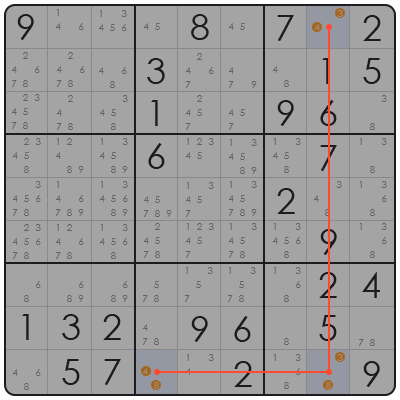
The candidate that both pincers share (which is not in the pivot) is called the "Victim" number. In this example, it is 4.
Step 3: Identify the Victim Cells and Eliminate
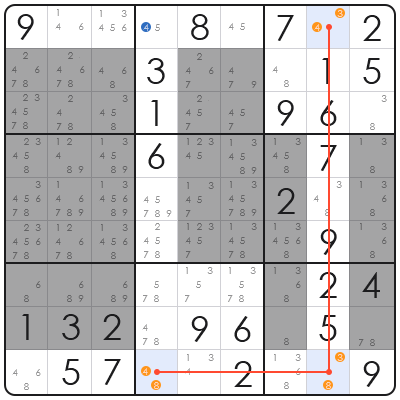
Now, look for any cell that can see both Pincer 1 and Pincer 2 simultaneously. This intersection is where the candidate eliminator happens. Since one of the pincers must be 4 (regardless of whether the pivot is 3 or 8), any cell seeing both pincers cannot contain a 4.
The Logic Behind the Wing Strategy
Why does the sudoku y wing work? Let's look at the logic chain:
- If the Pivot (R9C8) is 3, then Pincer 1 (R1C8) must be 4.
- If the Pivot (R9C8) is 8, then Pincer 2 (R9C4) must be 4
In either scenario, at least one pincer ends up being 4. Therefore, any cell at the intersection of these two pincers can never be 4. This is what makes it such a reliable sudoku technique.
Common Pitfalls in Y-Wing Sudoku
While mastering this wing strategy, beginners often make two mistakes:
- Non-Bi-value Cells: The strategy only works if all three cells (Pivot and two Pincers) contain exactly two candidates. This is essentially an advanced extension of the Naked Pairs logic. If any cell has three or more notes, the logic chain breaks.
- Incorrect Visibility: Both pincers must be able to "see" the pivot, and the victim cell must be able to "see" both pincers. If the cells don't share a house (row, column, or block), the elimination is invalid.
Put Your Y-Wing Skills to the Test
The sudoku y wing is an essential tool for any serious player looking to master complex grids. Since this advanced sudoku technique is most effective on tougher layouts, the best way to internalize it is by putting theory into practice.
We encourage you to challenge a Hard Sudoku or an Expert Sudoku puzzle to see if you can spot the pivot and pincers in a real game. Practice identifying these bi-value clusters in your daily sudoku puzzle to improve your speed and logical reasoning. Once you've conquered the Y-Wing, you'll be ready to explore even more advanced concepts like the Swordfish or XY-Chain!
Ready to Find Your First Y-Wing?
Y-Wing rarely appears in Easy puzzles — it’s designed for moments when all obvious logic is exhausted.
Turn on Notes and look for three bi-value cells forming a Pivot + two Pincers.
Tip: If removing one candidate suddenly unlocks the grid, you’ve found a real Y-Wing — not a coincidence.
Once Y-Wing feels natural,
👉 move on to Swordfish or XY-Chain, where eliminations extend across multiple rows and columns.