


"X-Wing" Technique
What is the "X-Wing" Technique?
"X-wing" is an advanced Sudoku technique, which is based on two parallel rows or two parallel columns. You shouldn't pay attention to the 3x3 blocks as they aren't involved in this strategy (only the rows and columns).
It will be easier to understand this technique if you look at the example.
How to Find an X-Wing
An X-Wing pattern forms when a candidate number (like '4') appears in:
- Exactly two cells in one row.
- Exactly two cells in another row.
- And these four cells form a perfect rectangle.
Step 1: Find the Pattern in Two Rows
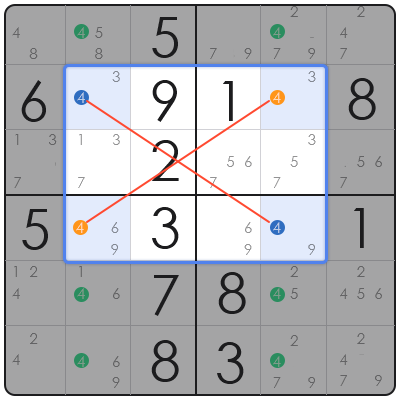
Let's take a look at two parallel rows: Row 5 and Row 7.
In Row 5, the candidate '4' appears in only two cells:
R5C5 (note {3, 4})
R5C8 (note {3, 4})
In Row 7, the candidate '4' also appears in only two cells:
R7C5 (note {4, 6, 9})
R7C8 (note {4, 9})
These four cells (R5C5, R5C8, R7C5, R7C8) form the four corners of a rectangle.
Step 2: The Logic of the Diagonal
Since 4s can't repeat in the same row or column, we can safely assume that the solution for '4' in these rows will be diagonal.
Case 1: The 4s are in R5C5 and R7C8.
Case 2: The 4s are in R5C8 and R7C5.
In both cases, one '4' is guaranteed to be in Column 5 and one '4' is guaranteed to be in Column 8.
Step 3: Eliminate Notes from the Columns
Now let's zoom out and take a look at the columns involved. Since a '4' must exist in Column 5 and Column 8 (in one of our rectangle's cells), no other cell in Column 5 or Column 8 can be a 4.
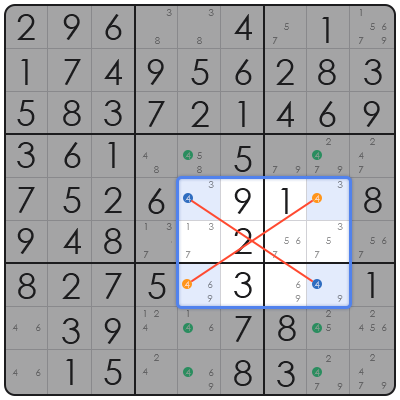
So, we can confidently remove '4' from all the remaining notes of these two columns.
In Column 5: We eliminate '4' from the notes in R4C5, R8C5, and R9C5.
In Column 8: We eliminate '4' from the notes in R4C8, R8C8, and R9C8.
Master This Advanced Technique
Now you know how to apply the X-wing technique in Sudoku! It's a powerful way to clean up notes and can proceed with the following advanced Sudoku strategy, "Y-Wing".
Ready to Spot Your First X-Wing?
X-Wing only appears when basic eliminations are exhausted — that’s why real practice matters.
Turn on Notes and scan two parallel rows or columns for a candidate that appears exactly twice in each.
Tip: If eliminating that candidate unlocks the puzzle immediately, you’ve found a real X-Wing — not a coincidence.
Once X-Wing feels clear,
👉 move on to Y-Wing, where elimination happens through candidate chains instead of rectangles.