


"Obvious Triples" Technique
What is an "Obvious Triple"?
This Sudoku solving technique is built upon the previous one, "Obvious Pairs". But "Obvious Triples" (also called "Naked Triples") is not based on two numbers, it's based on three.
This pattern occurs when three cells within the same house (a 3x3 block, row, or column) contain only candidates from a set of three numbers.
The Logic Behind It
To understand better, let's look at the example you provided. The three cells R7C7, R7C8, and R7C9 have notes of {5, 8}, {1, 8}, and {1, 5}.
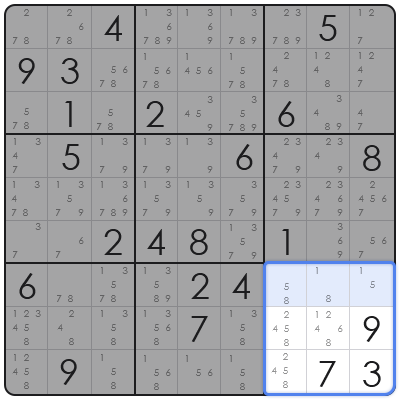
These three cells together "lock in" the numbers 1, 5, and 8. We know that one of them is 1, one is 5, and one is 8. What we know for sure is that 1, 5, and 8 can't be in any other cells of this block.
How to Use the "Obvious Triples" Technique
Let's look at the bottom-right 3x3 block from the example.
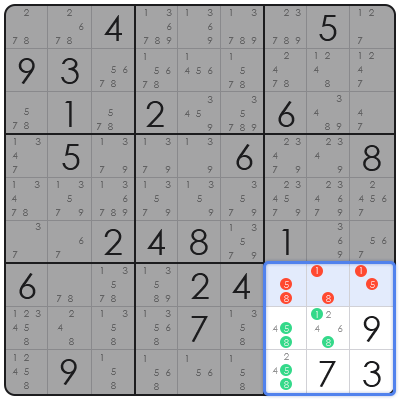
In this block, we can see the following filled numbers and notes:
Filled Numbers: 9 (R8C9), 7 (R9C8), 3 (R9C9).
- Key Notes (The Triple):
R7C7 = {5, 8}
R7C8 = {1, 8}
R7C9 = {1, 5}
- Other Notes ("The Victims"):
R8C7 = {2, 4, 5, 8}
R8C8 = {1, 2, 4, 6, 8}
R9C7 = {2, 4, 5, 8}
Step 1: Find the Triple
Look at the notes in the top row of this block (R7C7, R7C8, R7C9). Their notes are composed only of the numbers {1, 5, 8}. This forms a perfect "Obvious Triple".
Step 2: Eliminate Candidates
Because 1, 5, and 8 are locked into those three cells, they cannot appear in any other cell in this block.
We must now remove the '1', '5', and '8' notes from all other cells in this block.
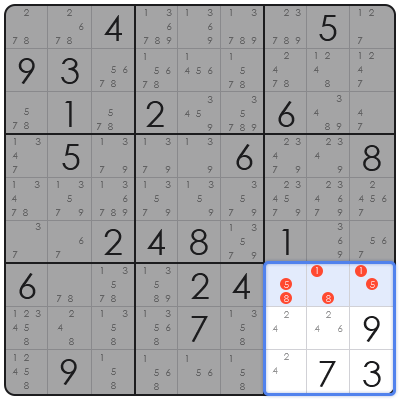
- For R8C7: Its notes are {2, 4, 5, 8}. After removing 5 and 8, only {2, 4} remains.
- For R8C8: Its notes are {1, 2, 4, 6, 8}. After removing 1 and 8, only {2, 4, 6} remains.
- For R9C7: Its notes are {2, 4, 5, 8}. After removing 5 and 8, only {2, 4} remains.
Step 3: Find the New Solution
After this cleanup, look at what we've found! Cells R8C7 and R9C7 now form a new "Obvious Pair" {2, 4}. This means 2 and 4 are locked in those two cells, which would let us remove 2 and 4 from cell R8C8, leaving {6} as a new "Obvious Single"!
Master This Advanced Technique
That is how the "Obvious Triples" technique works while solving Sudoku. It is a powerful tool for cleaning up notes and revealing the next solution.
Practice the “Obvious Triples” Technique in Real Sudoku Games
Obvious Triples rarely appear by accident — they only show up when your notes are
accurate and carefully maintained.
The fastest way to truly master this technique is to use it during real gameplay.
Choose a Hard or Expert puzzle, turn on Note mode,
and focus on rows, columns, or blocks where three cells share only three possible numbers.
Once you spot a triple, eliminate those candidates from the rest of the house
and watch new Obvious Pairs or Singles appear.
Tip: If a triple doesn’t immediately create a number,
keep scanning — Obvious Triples often work as a setup move rather than a final solution.