


2026 Guide to the Sudoku Packing Method: Master It Without Guessing

Solving Sudoku without guessing is possible—and fast—when you treat the grid like a capsule wardrobe: pack only what fits, and make everything work with everything else. The Sudoku Packing Method is a logic-first approach that organizes candidates by groups (rows, columns, boxes) and propagates constraints to “pack” each number into its rightful place. This guide explains what the method is, how it differs from naked and hidden pairs, and how to apply it step by step. You’ll also learn how to choose the next strategy when you’re stuck and why crisp pencil marks are non-negotiable. If you prefer clear moves over trial-and-error, this is your blueprint to master Sudoku without guessing.
Understanding the Sudoku Packing Method
The Sudoku Packing Method is a logic-driven approach that treats Sudoku as optimally packing candidates into the grid by using constraint propagation, group-wise reasoning, and elimination—so you never have to guess. Instead of hunting for isolated tricks, you work in organized “packs”: sets of candidates and units that must collectively fit without conflict.
Why the “packing” name? It parallels capsule wardrobe planning, where you curate a set of items that combine cleanly across outfits. The same compatibility mindset—minimizing clutter and maximizing workable options—maps neatly to Sudoku’s rows, columns, and boxes, a connection popularized in guides on the “packing Sudoku” wardrobe trick that emphasize making pieces interoperate across the whole set (see this clear explanation from Reader’s Digest on the packing-sudoku analogy). The method:
- Leverages group relationships (block–row–column intersections, “packing chains” of implications).
- Surfaces deterministic placements through elimination cascades.
- Reduces decision fatigue by clarifying a logical path—like solving a puzzle within a puzzle.
In practice, packing slots most standard 9×9 puzzles logically without backtracking, especially when combined with precise pencil marks and foundational tactics.
Differentiating Packing from Naked and Hidden Pairs
Naked pairs: Two cells in a row, column, or box that share exactly the same two candidates. Because those two values must occupy those two cells, you can eliminate those candidates from all other cells in the unit.
Hidden pairs: Two candidates that occur only in two cells within a unit—even if those cells list other candidates. Since those two values must go there, you can remove all other candidates from those two cells.
How packing compares:
- Packing Method: Systematic and global. It organizes candidates into coherent groups and chains across units, then prunes everything that doesn’t fit the combined picture.
- Naked Pairs/Triples: Localized, immediate eliminations by isolating exact pairs/triples in a single unit.
- Hidden Pairs/Triples: Distribution-based; you spot candidates that appear in only two (or three) cells and lock them in.
Comparison at a glance:
| Strategy | What it targets | Core action | Typical payoff | When to use |
|---|---|---|---|---|
| Packing method | Cross-unit groups and chains | Propagate constraints and eliminate globally | Clears clutter and reveals forced placements | When standard scans stall; to unify multiple small patterns |
| Naked pairs/triples | Exact same candidate sets in two/three cells | Remove those candidates from other cells in the unit | Fast, local eliminations | Early and mid-solve cleanup |
| Hidden pairs/triples | Candidates that only appear in two/three cells | Strip other candidates from those cells | Locks in positions | When distribution is lopsided in a unit |
Mini-examples:
- Naked pair in a box
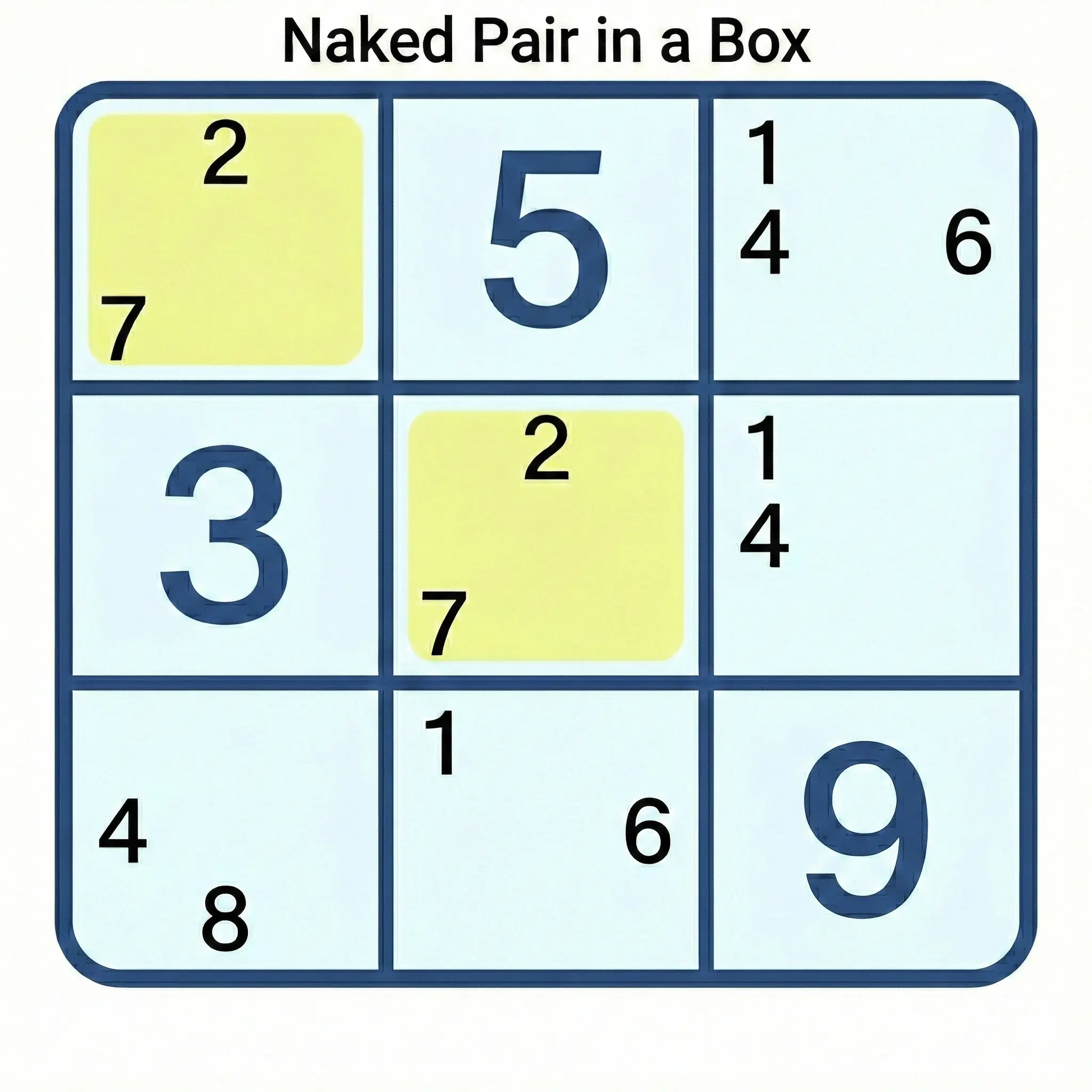
Result: Eliminate 2 and 7 from other cells in the box.
- Hidden pair in a row
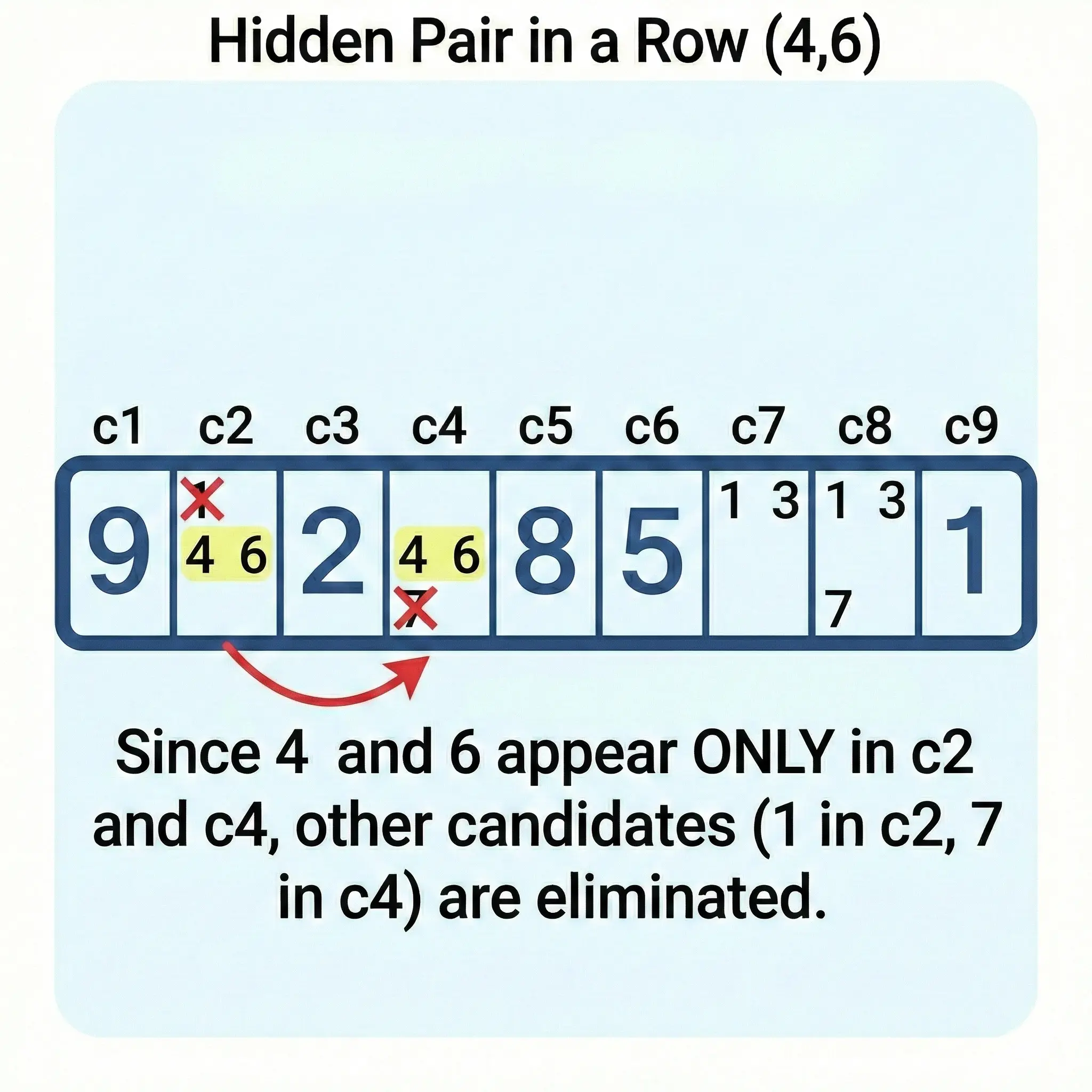
If 4 and 6 appear only in c2 and c4 across this row, reduce them to {4,6} in those cells and remove other candidates there.
Packing generalizes these ideas. By organizing candidates into compatible groups and extending implications across units, you naturally uncover naked/hidden sets along the way (see this “outfit grid for Sudoku solving” perspective on building cross-compatible sets).
Why Pencil Marks Matter and How to Use Them Efficiently
Pencil marks are small notations in empty Sudoku cells listing every candidate a cell could contain. They are the visibility layer that turns vague hunches into precise logic.
Benefits:
- Visualize constraints in each row, column, and box.
- Enable group eliminations (pairs, triples, block interactions).
- Reduce guesswork by making chains and packing relationships obvious.
Common mistakes:
- Forgetting to update marks after each placement or elimination.
- Over-marking without pruning, creating noise.
- Skipping marks in “easy” areas, then missing a forced move later.
Best practices:
- Add marks systematically after your initial scan.
- After every placement or elimination, immediately update affected cells.
- Prune ruthlessly: if a candidate is no longer viable, remove it.
Why it matters: Up-to-date marks power advanced logic—packing, pairs, and chains all rely on true candidate visibility. Treat them like your compatibility grid; stale notes hide solvable steps.
Quick contrast:
| Up-to-date marks | Outdated marks |
|---|---|
| Row now has a 3 placed; all 3s removed from peers instantly | Row still shows 3 in peer cells, blocking a hidden single |
| A naked pair {5,9} is clear; other 5s/9s pruned in the unit | Pair is masked by leftover candidates, no elimination happens |
Step 1: Define Your Puzzle Constraints and Goals
Think like a packer: plan first, don’t improvise. Before writing a number, frame the puzzle:
- Scan the givens and note overall difficulty.
- Flag constrained areas: nearly complete rows/columns/boxes, asymmetric clue patterns, and “tight” intersections.
- Set goals: complete grid, no guessing, logical eliminations only.
The capsule-packing analogy applies—curate deliberately, aim for maximal compatibility across the whole set (see this overview of the packing-sudoku concept for how planning amplifies options).
Step 2: Identify Core Candidate Groups for Packing
Build your base set—the candidates and units that will drive early logic.
Look for:
- Singles (only one candidate fits in a cell).
- Nearly complete units (last or last-few missing numbers).
- Naked pairs/triples you can isolate quickly.
- Block–row–column intersections where a candidate in a box is confined to one line.
Core group types to prioritize:
- Singles
- Naked pairs/triples
- Block–row–column intersections
As you identify these, “pack” them: place forced numbers, eliminate incompatible candidates, and let each action ripple. This mirrors an outfit grid where each addition reduces uncertainty and increases clarity about what fits with what (nicely captured in this outfit-grid framing of Sudoku packing).
Step 3: Arrange Candidates to Ensure Compatibility Across Rows and Columns
Now test compatibility so that every candidate works with every other in its context.
Step-by-step:
- Populate each empty cell with accurate pencil marks.
- Scan each row, column, and box:If a candidate appears only once in a unit, place it.If a naked pair/triple emerges, eliminate those values from the rest of the unit.If a candidate in a box is confined to one row/column, eliminate that candidate from the same row/column outside the box (pointing).
- After each action, immediately refresh marks and re-scan.
Think of it as outfit compatibility: if a piece can’t combine across the set, it doesn’t belong. Capsule planners often stress ensuring wide mix-and-match compatibility—this is a helpful mental model for pruning Sudoku candidates (see this capsule-compatibility guide that frames choices around interoperability).
Step 4: Test, Adjust, and Validate Each Group for Complete Coverage
Iterate with discipline:
- Verify coverage: in every unit, account for all digits 1–9 via placements or live candidates.
- Validate ripples after each placement: update marks, confirm no unit has duplicate numbers or zero candidates for any digit.
- If a contradiction appears, back up to the last confirmed checkpoint, correct marks, and proceed.
A simple validation loop:
- Place or eliminate.
- Update marks in all affected peers.
- Re-check for singles, pairs/triples, and pointing.
- Re-scan intersections for fresh constraints.
Just as travel-capsule planners refine their outfit grid and swap pieces that don’t pull their weight, adjust your candidate packs until every number contributes cleanly (for a practical planning mindset, see this capsule + planner approach that emphasizes iterative refinement).
Step 5: Use Strategic Editing to Avoid Guessing and Overpacking
Logic beats speculation. Edit your grid like you edit a suitcase:
- Don’t add speculative “just in case” moves. If a candidate cannot be justified by unit constraints or chains, it stays out.
- If a candidate never participates in a viable placement after several passes, re-check its premises—it may be “filler” created by an outdated mark.
- Keep pruning: fewer, truer candidates sharpen the next forced step and prevent cognitive clutter.
A common capsule-packing mantra is to replace any piece that only works in one outfit before you close the suitcase; in Sudoku terms, remove candidates that don’t integrate across the row/column/box network. This editing habit keeps your solve path efficient and guess-free.
Choosing the Right Strategy When You Get Stuck
Use this quick decision path:
- See singles? Place them now.
- Notice pairs/triples? Apply naked/hidden logic.
- No progress? Check block–row–column interactions (pointing/claiming).
- Still stuck? Widen scope with packing chains: test cross-unit implications to eliminate incompatible candidates.
- Refresh pencil marks after every action, then rescan from the top.
Switching strategies isn’t failure—it’s how logical solvers move forward. For deeper stuck scenarios and higher-order tactics, see our guide on How to Solve Difficult Sudoku.
Essential Sudoku Strategies to Learn Before Packing
Master these in order to make packing effortless:
- Scanning and basic elimination (find singles and last-remaining cells).
- Pencil marks for accurate candidate tracking.
- Naked pairs/triples and hidden pairs/triples.
- Pointing pairs/triples and block intersections.
- Introduction to packing (grouping and chains over sets).
Use these resources next:
With these foundations, the packing method feels natural: you’ll see candidate groups, propagate constraints, and solve cleanly without guessing.
Frequently Asked Questions
What is the Sudoku Packing Method?
The Sudoku Packing Method “packs” candidates into cells by organizing them into cross-unit groups and propagating eliminations, enabling a clean, no-guessing solve path even on tough puzzles.
How do I know which strategy to try next when I’m stuck?
Scan for singles, then pairs/triples, then block interactions; if none appear, use packing chains to extend implications across units and re-open eliminations.
What is the difference between naked pairs and hidden pairs?
Naked pairs are two cells with exactly the same two candidates; hidden pairs are two candidates that appear only in two cells within a unit—both lead to targeted eliminations.
Why is it important to keep pencil marks updated?
Accurate marks reflect real constraints, prevent errors, and unlock advanced logic like packing and pairs without resorting to guesses.
Which Sudoku strategies help avoid guessing?
Singles, naked/hidden pairs, block interactions, and the Sudoku Packing Method all support pure, logic-only solving.