


How to Solve Sudoku: A Beginner's Guide to Mastering the Logic Puzzle
Unlock the secrets to solving Sudoku puzzles! This comprehensive guide will take you from a complete beginner to a confident Sudoku solver. Learn the fundamental rules, discover effective sudoku strategies, and transform your brain into a logic powerhouse. Are you ready to embark on your Sudoku journey?
Why Sudoku is the Perfect Brain Workout
Sudoku: More Than Just a Game
Do you shy away from Sudoku, daunted by the seemingly complex sudoku grid? Perhaps you fear losing hours to a single puzzle?
Logic and Deduction, Not Math
Let's dispel those myths. Sudoku isn't about advanced math; it's a game of pure logic and visual deduction.
Your Brain: The Sudoku Detective
Forget complex math. Your brain works like a detective. It looks for patterns and finds the "one correct" number for each empty cell.

Brain imaging studies confirm the cognitive benefits. Research shows that solving Sudoku puzzles, even the simple 3x3 ones, raises oxygen levels in important brain areas. It also lowers the level of oxygen-poor hemoglobin. (p<0.0001).
Boosting Brain Function with Sudoku
This shows increased activity in the prefrontal cortex. This area is in charge of logical reasoning, decision-making, focus, and short-term memory. Think of it as a brain "yoga session," refreshing your mind during short breaks. (Research source: “Role of prefrontal cortex during Sudoku task: fNIRS study” (2020))
Mastering Sudoku for Brain Health
This guide will redefine your understanding of Sudoku. We'll teach you "visual logic" and demonstrate how modern tools make solving puzzles intuitive. Whether you're a beginner or looking for brain-boosting activities, this is your tailor-made path to Sudoku mastery. Let's demystify how to solve Sudoku. Sudoku is a fantastic logic puzzle that can be enjoyed by everyone.
Sudoku Rules Explained Simply: The Basics in Under 3 Minutes
The Core Goal: Completing the Grid
Remember: No Repeats, No Gaps – Every Number in Its Place
Understanding the Sudoku Grid
Imagine managing a 9-story apartment building. Each floor (row) has 9 units, and each unit (column) has 9 rooms. Your job is to ensure that:
- Every floor has the numbers 1 through 9.
- Every vertical pipe (column) has the numbers 1 through 9.
- Every 3x3 section, known as a “palace,” has the numbers 1 through 9. Each number must appear exactly once, with no repeats or missing numbers. This is sudoku explained simply.
Key Sudoku Terms
- Row: A horizontal block of 9 cells.
- Column: A vertical block of 9 cells.
- Palace: A 3x3 grid section outlined by thick lines (9 palaces total).
These are the complete sudoku rules explained. You start with "known numbers" on the grid. Your goal is to deduce the correct number for each empty cell based on these clues. For the easiest win, look for a row or box with only one empty spot—this is known as the Last Free Cell.
Simple Example: A Step-by-Step Walkthrough
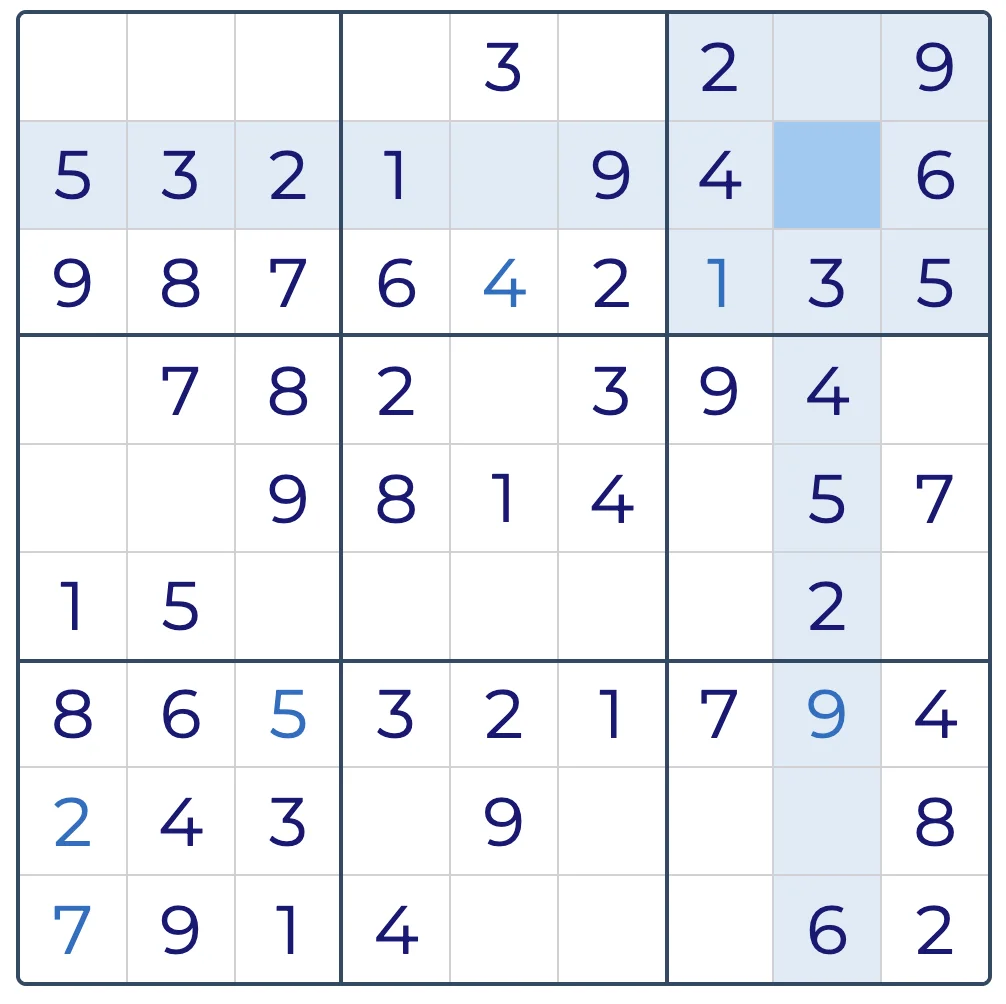
Let's look at a simplified example to illustrate the basic principles:
Starting Strategy: Focus on the Most Clues
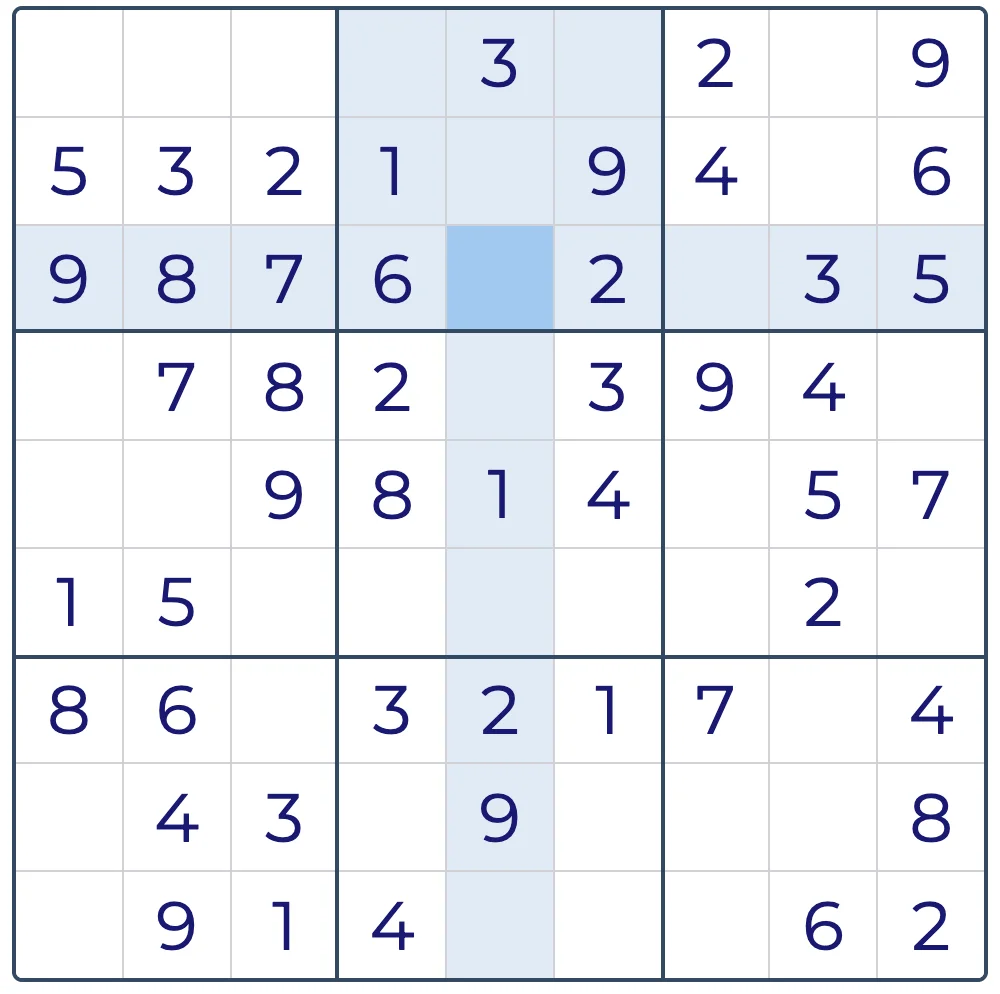
1. When starting a Sudoku puzzle, begin with the region/row/column containing the most known numbers. In this example, the third row is missing only 1 and 4. Observe the highlighted cell R3C5 (row 3, column 5). Its region already contains the number 1 (R2C4), so R3C5 must be 4. R3C7 is filled with 1.
Process Demonstration: Filling the First Numbers
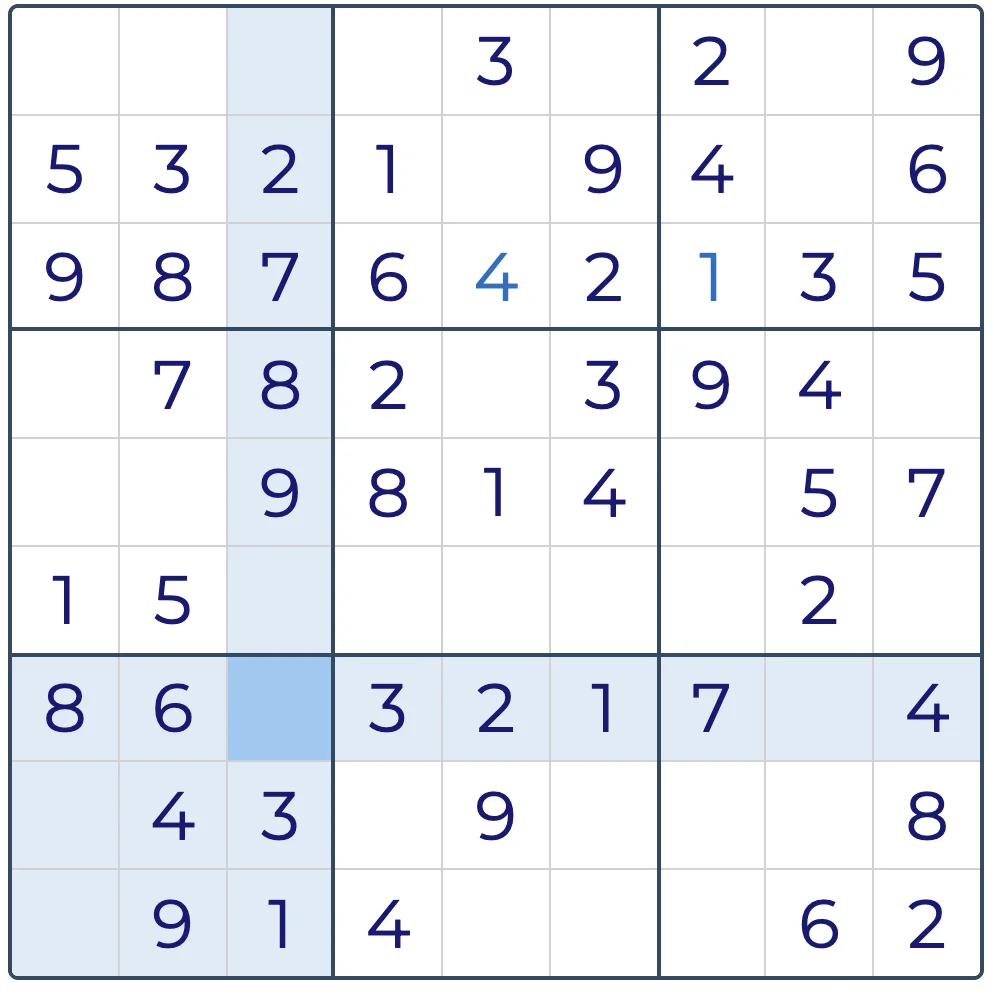
2. Moving on, row 7 also lacks only two numbers: 5 and 9. The highlighted cell R7C3 (row 7, column 3) is in a column with the number 9. So, the number in R7C3 must be 5. R7C8 is filled with 9.
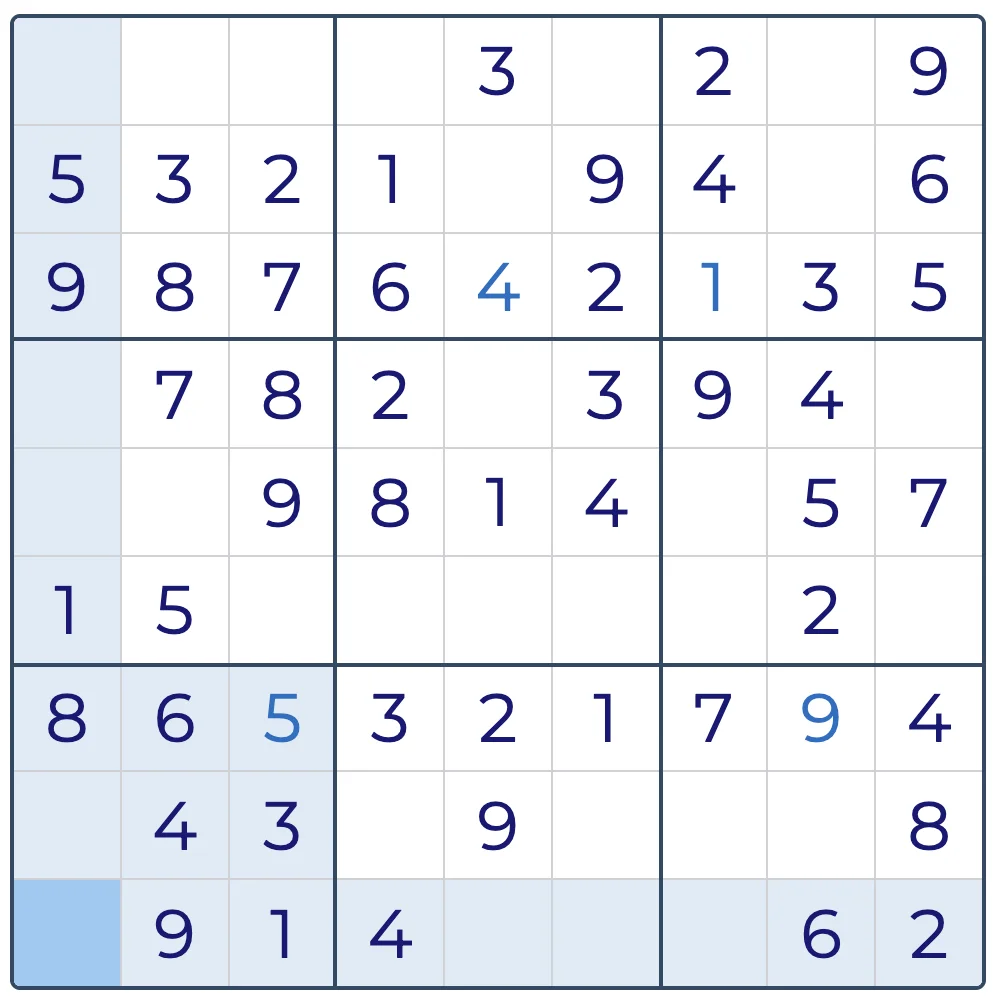
3. Now, the bottom-left 7x7 region also only lacks the numbers 2 and 7. The row with the highlighted cell R9C1 (row 9, column 1) has the number 2. This means the number in R9C1 must be 7. The cell R8C1 already has the number 2.
Applying the Method to Advanced Areas
As beginners fill in more numbers, they can keep using this method. This systematic identification of Obvious Singles is the fastest way to clear out the "low-hanging fruit" on any game board before moving to harder sections.
Advanced Sudoku Solving Techniques
While the basic rules are simple, Sudoku puzzles can range in difficulty. The most critical step toward intermediate play is identifying Hidden Singles—where a number can only fit in one specific cell within a house, even if that cell has other potential candidates.
Essential Techniques: From Scanning to Marking
- Scanning: Orderly checking rows, columns, and palaces for potential candidates.
- Marking Candidates: Noting down possible numbers for each empty cell to visualize potential solutions.
Spotting Patterns: Hidden Singles and Naked Groups
- Hidden Singles: Identifying a number that can only appear in one specific cell within a row, column, or palace.
- Obvious Pairs/Triples: This means finding two or three cells in a row, column, or box. These cells have only two or three possible numbers. This allows you to eliminate those candidates from other cells in the same row, column, or palace.
Practice Exercise: Apply Techniques on a Puzzle
Now, try applying these techniques to solve the puzzle here!
Tips for Sudoku Success
Mindset and Habits for Effective Solving
- Start Simple: Begin with easy puzzles to build your confidence and understanding.
- Be Patient: Sudoku requires focus and attention to detail. Don't rush.
Tool Usage and Time Management
- Use Sudoku Notes: Write candidate numbers in notes tool, allowing you to erase and adjust as you solve.
- Take Breaks: If you get stuck, take a break and come back with fresh eyes.
Building Long-Term Skill Through Practice
- Practice Regularly: The more you play, the better you'll become at recognizing patterns and applying solving techniques.
Ready to Try Your First Sudoku Puzzle?
Now that you understand the rules and basic solving techniques, the best way to learn is to start solving. Begin with an easy Sudoku puzzle. Take your time. Use logic, not guessing.
Solve your first puzzle now on LoveSudoku.net and see how these logical rules come to life!