


Sudoku for Beginners: A Step-by-Step Guide from Zero to Independent Solving (with Lovesudoku Practical Guide)
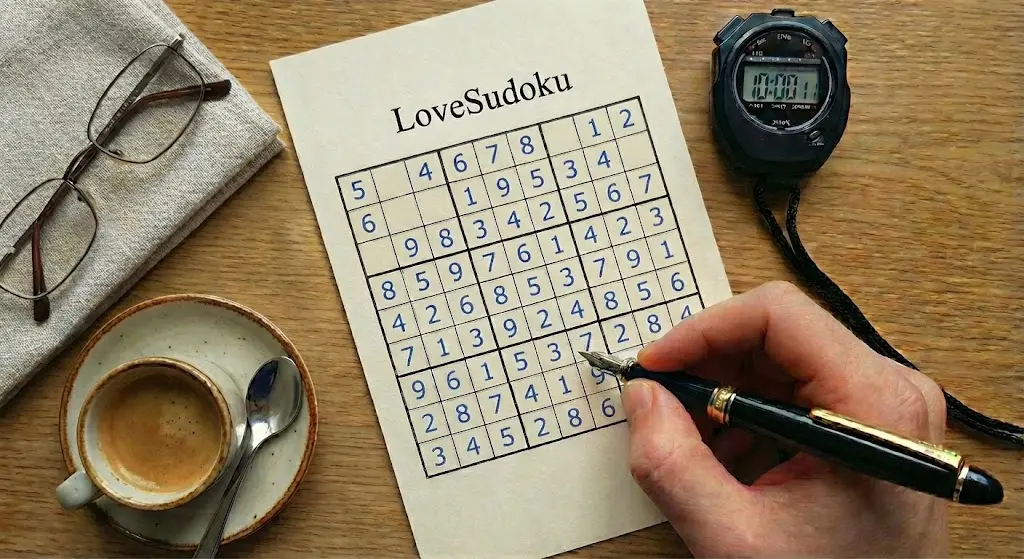
Have you ever picked up a Sudoku puzzle, stared at the grid filled with numbers, and felt completely lost? Or perhaps you filled in a few numbers, only to find your logic stuck, forcing you to give up entirely? You are not alone. Many people mistakenly believe that Sudoku requires advanced mathematical knowledge, or that only geniuses can solve these complex puzzles.
In fact, Sudoku is a game of pure logic; it has nothing to do with mathematical calculations. This article will provide you with a systematic guide to go from zero basis to independent solving. We will help you break through the "beginner's block" and, combined with the practical tools at Lovesudoku.net, start a fun-filled journey of logical thinking training.
Why Choose Sudoku? What Can It Bring You?
In our fast-paced lives, Sudoku is more than just a game to kill time; it is a "gym" for your brain.
Pure Logic Challenge, No Math Required
This is the biggest misconception among beginners. According to professional sources like SudokuOnline.io, Sudoku involves numbers, but it is essentially a game about pattern recognition and logical elimination. Even if you are bad at arithmetic, as long as you can distinguish 9 different symbols (even shapes or letters), you can play Sudoku. It tests your observation and reasoning skills, not your calculation ability.
Train Your Brain, Improve Focus and Problem-Solving
In this era of fragmented information, maintaining focus is becoming increasingly difficult. Research by Senior Lifestyle points out that regular Sudoku training acts as a "cognitive workout," helping to keep the brain active and even delaying cognitive decline. When you immerse yourself in the world of the 9x9 grid, you need to use both short-term memory (remembering candidates) and logical analysis (elimination). This deep brainstorming effectively improves your logical thinking and problem-solving abilities.
The Best Companion for Spare Time: Enjoy Fun Anytime, Anywhere
Whether on a commuter train or during a short lunch break, Sudoku allows you to quickly enter a state of "flow." It doesn't require bulky equipment or large blocks of time. The sense of achievement from solving a puzzle can quickly sweep away work fatigue. It is a healthy and high-quality way to relax.
Sudoku Basic Rules: The "Map" You Can Read at a Glance
To master how to play Sudoku, you first need to understand its "map." Standard Sudoku consists of a large 9x9 grid, and we need to fill in the numbers 1 to 9.
The World of the 9x9 Grid: Rows, Columns, and Boxes
The structure of Sudoku can be broken down into three dimensions, which are the foundation of solving:
- Row: The 9 horizontal cells, counting from left to right.
- Column: The 9 vertical cells, counting from top to bottom.
- Box: The 3x3 mini-grids divided by bold lines. There are 9 Boxes in the entire grid.
The Principle of Uniqueness for 1-9
There is only one core rule in Sudoku, simple yet rigorous:
In every Row, every Column, and every 3x3 Box, the numbers 1-9 must appear, and can only appear once.
In other words, no number can be repeated in any Row, Column, or Box. This is the fundamental basis for our logical reasoning—Uniqueness.
Understanding Difficulty Levels: Why Are Some Puzzles Harder?
Many beginners are scared off by different difficulty levels when trying to learn Sudoku.According to Senior Lifestyle, how hard a Sudoku puzzle is does not depend on the number of clues. Instead, it depends on the logical depth needed to solve it.
- Easy/Beginner: Can be solved by intuitive observation (Scanning).
- Medium/Hard: Requires the use of Candidate notes (pencil marks) and simple elimination methods.
- Expert/Master: Requires complex logic chains (such as X-Wing, XY-Wing) to find a breakthrough.
3 Essential Strategies for Beginners: Say Goodbye to "Being Stuck"
For Sudoku beginners, nothing is more painful than staring blankly at the board. Master the following three basic strategies, and you will be able to solve your first puzzle quickly.
Strategy 1: Look for "Last Free Cell", "Last Remaining Cell", or "Last Possible Number"
These are the simplest techniques to break into a puzzle.
- Last Free Cell: Check every Row, Column, or Box. If a Row already has 8 numbers filled in and only one empty space remains, then the number for this cell is definitely the missing one from 1-9. This is absolute certainty.
- Last Remaining Cell: (Also known as Hidden Single) If a number appears in a certain Row or Column, it cannot appear again in the Boxes that the Row or Column passes through. This often leaves only one specific cell in a Box where that number can go.
- Last Possible Number: (Also known as Naked Single) If 8 different numbers have already appeared in the Row, Column, and Box associated with a specific cell, then that cell can only be filled with the one remaining number.
The fastest way to understand these rules is to try it yourself.
See how quickly you can spot the missing number in a real puzzle.
Strategy 2: Global Scanning—Don't Stare at One Spot
Many beginners tend to get stuck in one local area. The correct Sudoku gameplay step is to learn "Scanning" (Cross-hatching).
- How to do it: Select a number (e.g., 1) and observe its distribution in all Boxes. Using the rule of "no repetition in Rows and Columns," mentally draw lines to eliminate impossible positions. You will often find that in a certain Box, there is only one cell left where "1" can be placed.
- Tip: Scan from 1 to 9 in order; you can often harvest a wave of confirmed numbers.
Strategy 3: Review Immediately After Filling a Number
Sudoku is a dynamic system. When you fill in a new number, it changes the state of the Row, Column, and Box it is in.
- Chain Reaction: The "5" you filled in at position A might rule out a possible "5" at position B, leaving position B with only one option, like "6".
- Habit Formation: Even if you fill in the simplest number, immediately look at what impact it has on the surroundings. This is the key to breaking a deadlock.
Avoid Common Pitfalls and Improve Efficiency
In the process of learning Sudoku tutorials, avoiding pitfalls is as important as learning techniques.
The Danger of Blind Guessing
Sudoku is a logic game, not a game of luck. Unless you are in an extremely high-difficulty "trial and error" stage, guessing is strictly prohibited.
- Consequences: If you guess one number wrong, all subsequent reasoning is built on a false foundation. This will eventually lead to contradictions on the board, forcing you to erase everything and start over, which is extremely discouraging.
Carelessness: The Importance of Checking
Many users report, "I thought I filled it in correctly, but the system reported an error." This is usually because row and column checks were ignored.
- Suggestion: Develop the habit of scanning the whole board regularly to ensure that the "Uniqueness" rule is not violated. Reviewing your mistakes is a shortcut to improving your skills.
Lack of System
Don't fill in numbers randomly here and there. Many Sudoku experts mention that a lack of a systematic solving process leads to low efficiency. To build a solid foundation, we recommend following our comprehensive guide on How to Solve Sudoku. It will teach you the exact "Scan -> Mark -> Solve" workflow used by professionals.
How to Continue Improving? The Exclusive Training Path at Lovesudoku.net
To solve the problems of "lack of progress" and "lack of feedback" for novices, Lovesudoku.net has built a unique training system, which is the core recommended platform for the Lovesudoku Guide.
Gradual Difficulty Gradient: From Novice Village to Expert Hall
Unlike the rough difficulty divisions of ordinary apps, Lovesudoku.net provides fine-grained difficulty training packs. It won't let you face insurmountable walls directly but acts like a fitness coach, letting you master complex logic unconsciously through small difficulty increments.
Interactive Teaching and Practice: Visual Feedback Helps You Grow
The platform uses visual teaching. When you select a number, the related Rows, Columns, and Boxes will be highlighted, making conflict points clear at a glance. This instant feedback mechanism allows you to understand logic relations much faster than solving on paper.
Your Exclusive "Mistake Book": Smart Review for Precise Improvement
Addressing user pain points, Lovesudoku.net provides a smart review function. It not only tells you that you are wrong but also shows which step of logic went wrong. By replaying the solving process, it transforms every mistake into experience points.
Play Sudoku Anytime, Anywhere: Mobile Offline Mode & Progress Save
Perfectly adapted for mobile devices, it supports offline mode and cloud progress synchronization. Whether on a flight in airplane mode or in a subway with poor signal, your solving progress will never be lost, truly realizing the effective use of fragmented time.
Start Your Sudoku Journey Now!
The door to the world of Sudoku is open for you. You don't need to prepare an eraser, nor do you need to worry about dirtying the paper.
Visit Lovesudoku.net to Start Your First Game
Open your browser and visit Lovesudoku.net now, and select the "beginner" mode. Use the "Last Free Cell", "Last Remaining Cell", and "Last Possible Number" techniques introduced in this article to experience the thrill of filling in your first number.
Start Your Journey at Lovesudoku Now →
More Advanced Strategies Coming Soon
When you conquer the basic levels, don't stop. According to authoritative sources like PennyDellPuzzles, there are more advanced strategies like X-Wing, XY-Wing, and Swordfish waiting for you to explore. Lovesudoku.net will accompany you from a Sudoku beginner to a true logic master.